
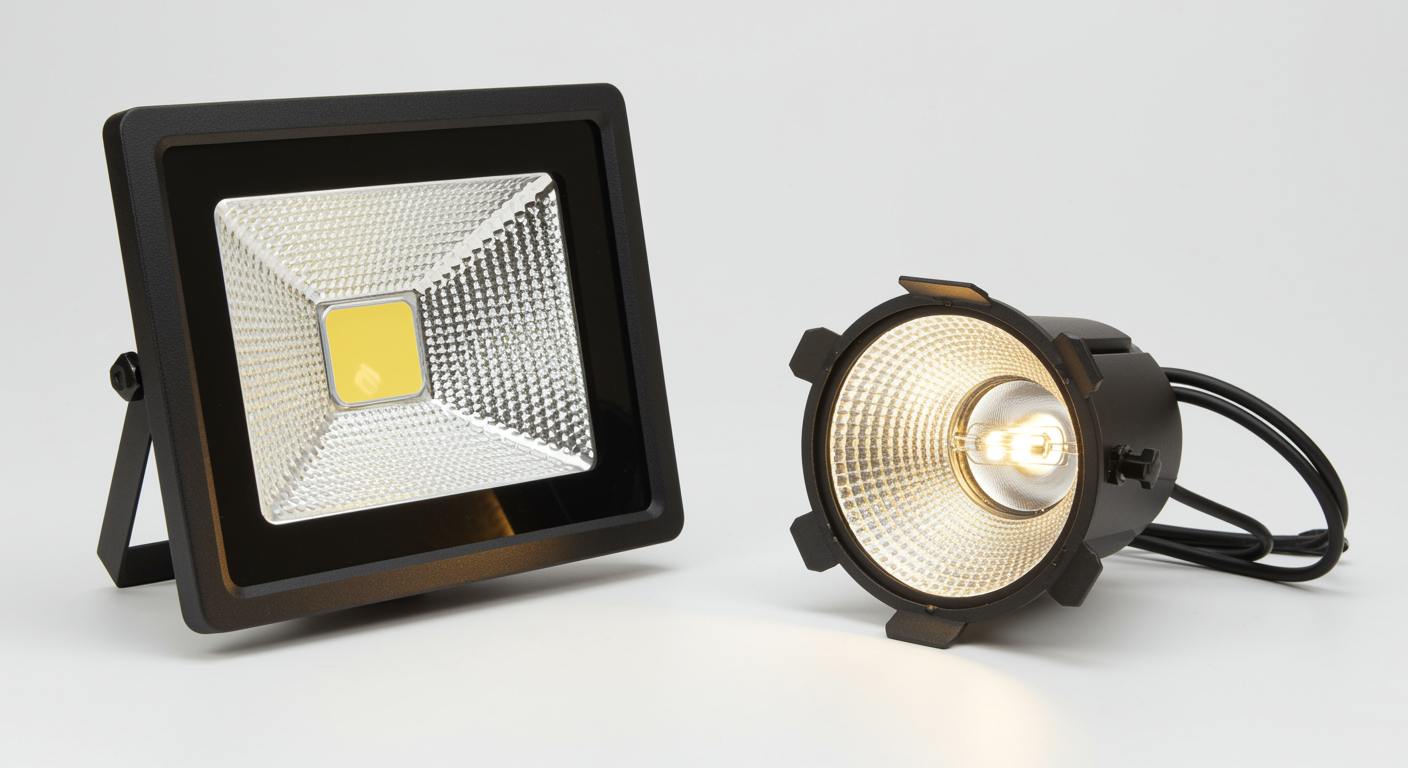
Choosing between LED floodlight vs halogen has become a common dilemma for homeowners, business owners, and leading facility managers. With numerous lighting options available for various purposes, people often become confused about the trade-offs between cost, brightness, lifespan, safety, and long-term value. Halogen lights offer decent brightness, while the LED floodlights promise lower energy bills as well as far longer service life.
In this guide, we will break down each of the factors, including efficiency, heat emissions, brightness, LED flood light vs halogen lifespan, safety, and environmental impact. All these factors can help you make an informed decision tailored to your specific needs.
LED Floodlight Energy Efficiency vs Halogen Power Consumption
When comparing different factors between the LED floodlight vs halogen, energy efficiency is always considered as the biggest differentiator.
While the Halogen floodlights use a perfect heating filament that not only produces superior light but also consumes a high wattage, ensuring greater brightness, the 500W halogen floodlight is also very common in security applications, commercial settings, and on various construction sites.
Compared to it, the LED floodlights also convert energy directly into light, with minimal heat loss. A 100W LED floodlight can also produce similar brightness to a 400–500W halogen lamp, often resulting in 65–80% energy savings.
Real-world impact:
If a halogen floodlight runs for 6 hours nightly, it could also consume up to 90 kWh per month for creating the halogen brightness. An equivalent LED floodlight would also consume around 18–25 kWh for the same output. Over the course of a year, that translates to noticeable savings on electricity bills, especially in commercial or security applications where lighting runs for long hours.
Lifespan Comparison: How Long LED vs Halogen Floodlights Last
To cover typical lifespans, LEDs often last 25,000-50,000 hours, compared to halogens’ 2,000-5,000 hours, and how that impacts replacement frequency & maintenance.
| Type | Average Lifespan | Maintenance Frequency |
| Halogen lifespan | Typically, 2,000–5,000 hours | Frequent replacements (especially for the outdoor fixtures) |
| LED floodlight lifespan | 25,000–50,000 hours | Replace once every few years or even a decade |
Frequent bulb changes increase labour costs and inconvenience, especially for mounted floodlights installed high on poles or walls. LEDs also maintain their brightness for longer periods without drastic dimming over time, whereas halogen brightness tend to degrade more quickly.
Brightness, Light Quality & Colour Temperature
Brightness perception is another major factor that must be considered in the case of LED floodlight vs halogen debate.
- Halogen brightness always appears warm and intense. Another excellent feature of this light is its excellent natural colour rendering. This makes halogen lighting a very popular option in photography and various applications where natural tones are important.
- LED floodlights also offer a wider range of multiple colour temperatures, from warm white (3000K) to daylight (6000K). Thus, the light provides users with greater flexibility, depending on the desired ambiance or purpose.
In terms of the beam distribution, modern LEDs also provide a proper and even light spread without hotspots. While the halogen lights may create concentrated brightness, halogen brightness often lacks uniform coverage. Similarly, for security lighting, warehouse illumination, or landscape lighting, LEDs can often deliver better light spread with proper controlled glare.
Heat Emission & Safety: LED Floodlight Safety vs Halogen Risks
Halogen emissions include not just a light but a significant amount of heat. Halogen floodlights can reach high surface temperatures, increasing risks such as:
- Fire hazards near dry leaves, fabric, or wooden structures.
- Burn risks if touched by accident.
- Energy loss due to excessive heat generation.
LED floodlight lifespan allows the light to stay cool, even after long hours of continuous operation. This makes the lights, both LED and halogen, much safer for both indoor and outdoor use. Furthermore, the lower heat emission also contributes to longer fixture life, as components are less likely to be damaged due to thermal stress.
Costs — Upfront vs Long-Term Savings with LED vs Halogen Floodlights
Initial cost is also a factor, and it is a fact there are halogen floodlight advantages still exist. However, a typical halogen fixture might cost significantly less than an LED.
However, the true cost of these lights includes:
- Energy usage over time
- Replacement costs due to the short halogen lifespan
- Low maintenance costs and labour
- Heat-related damage or low efficiency
| System | Initial Cost | Annual Energy Cost* | Replacement/Service | 3 Year Total Timing |
| Halogen Floodlight | Low | High | Frequent | Highest |
| LED floodlight | High | Low | No replacement for long years | Lowest |
Moreover, based on an average of 6 hours of daily usage.
Furthermore, despite a slightly higher upfront price, the LEDs easily pay for themselves within one to two years of continuous usage. Therefore, the LEDs are chosen as a smarter choice for long-term investment.
Environmental Impact: LED Floodlights vs Halogen Carbon Footprint
While deciding between LED floodlights vs halogen, considering the environmental impact and carbon footprint is an important decision factor.
- Halogen lifespan is much lower. This is because while the halogen lights consume more energy, this also leads to higher carbon emissions from electricity production.
- Also, sometimes frequent replacements mean more waste.
- Halogen emissions also include heat waste, which contributes to some unnecessary energy loss.
On the other hand:
- LEDs consume significantly less electricity. This, as a result, reduces the power plant demand as well as the greenhouse gas production.
- The long lifespan also means less landfill waste.
- LED lights do not emit excessive heat; thus, this particular light turns out to be a much eco-friendly option.
For any business or homeowner trying to reduce their energy footprint, LED floodlight lifespan are a clear winner.
When Halogen Still Has a Place: Situations Where Halogen Floodlights Might Be Useful
While the LEDs dominate most of the aspects, there are still some scenarios where halogen floodlight advantages might apply:
- Very low initial budget
For temporary installations, this option provides quick and cost-effective lighting.
- Colour preference & CRI
Some photographers and artists often prefer the halogen due to its natural tone.
- Existing fixtures not compatible with LED retrofits
In some cases, replacing the entire fixtures may add much higher cost along with some greater complexity.
- Easy access installations
Replacement is simple in the case of halogen, and some users might still opt for the halogen.
However, even in some cases, it’s essential to consider the short halogen lifespan and high halogen emissions against the long-term operating costs.
Which Lighting Should You Choose for Your Situation? LED or Halogen?
Here’s a quick recommendation based on usage needs:
| Use Case | Some Recommended Option |
| Home patio or garden lighting with some occasional use | LED are better options for better efficiency and ease |
| Security floodlights running all night | LED floodlight lifespan helps with High savings on the electricity bills |
| Construction site temporary lighting | Halogen if budget is low |
| Industrial warehouses or car parks | Longer lifespan and low maintenance |
| Photography or studio lighting with CRI priority | Halogen are preferred, but there are LEDs with this feature is available too |
Conclusion
In case of LED floodlight vs halogen comparison, LEDs always take the lead. This is due to the superior energy efficiency, extended LED floodlight lifespan, greater safety resulting from low heat emissions, and overall environmental benefits.
However, Halogen still has a few niche use cases where a very low upfront cost or specific colour rendering is desired. However, despite its short lifespan and high energy consumption, the Halogen proves to be a costly choice in the long run.
Overall, to make the best choice, consider the usage frequency, energy bill concerns, halogen brightness needs, and also different safety or environmental impacts. Additionally, for the most modern homes and businesses, LED floodlights are a future-proof and cost-effective upgrade that is worth investing in.
FAQs:
1. How many watts of LED floodlight are equivalent to 500W halogen?
The Collingwood 50W LED Floodlight is equivalent to a 500W halogen bulb. Due to a wide and perfect 120° beam angle and unique 360° rotation, this 50W flicker-free floodlight is considered ideal for proper outdoor use. These lights are also perfect for lighting large areas, courtyards, and entrances.
2. Is LED lighting better for outdoor security than halogen?
Yes, LED lighting is a better option for ensuring outdoor security than halogen brightness because it is more durable and energy-efficient. Additionally, such lights also provide a better quality of light for proper identification and surveillance. LEDs work in multiple weather conditions, producing a much crisper and more focused beam.
3.Do LED floodlights lose brightness over time (lumens depreciation)?
Yes, the LED floodlights do lose brightness over time, a phenomenon known as lumen depreciation. Unlike the traditional bulbs that fail suddenly, the LEDs dim gradually as the semiconductor material often degrades. This decrease also slows, with some high-quality lights often rated to retain at least 70% of their initial brightness after 50,000 hours of use.
4. Can I retrofit my halogen floodlight fixture with an LED bulb or module?
Yes, you can easily retrofit a halogen floodlight fixture with an LED bulb or module. But, before doing this, it is necessary to check the important compatibility and other safety factors to consider. A successful retrofit usually depends on your specific fixture.
5. What colour temperature should I choose for LED vs halogen?
An LED bulb often matches the warm and yellowish light of a halogen. So, choose a colour temperature of around \(2700K3000K\). While the Halogens are typically \(3000K\), but LEDs are available in a wider range, from warm whites (\(2700K3000K\)) for cosy areas to cooler, brighter whites (\(5000K\) and above).
6. Are LED floodlights more expensive to buy?
LED floodlights typically have a higher upfront cost compared to some traditional lighting options, but they offer long-term savings through lower energy consumption, minimal maintenance, and a longer lifespan.